Aoi Bungaku Series (2009)
青い文学シリーズ
Information
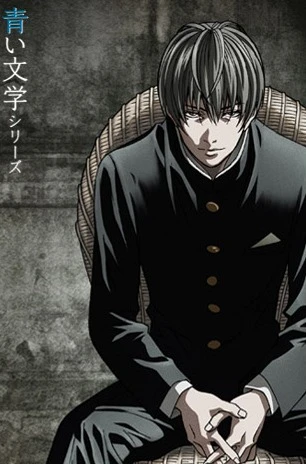
 Aoi Bungaku Series 青い文学シリーズType: TV-Series, 12 (~, Total: ~5 h)Status: CompletedPublished: 11.10.2009 ‑ 26.12.2009Season: Fall 2009Studio: MADHOUSE Inc.Staff: Ango SAKAGUCHI, Osamu DAZAI (Original Work), Atsuko ISHIZUKA, Morio ASAKA (Direction), Kunio KATSUKI, Masanori SHINO (Character Design), Hideki TANIUCHI, Shuusei MURAI (Music)Adapted From: NovelWebsite: NTV
 Youth LiteratureStatus: Completed DubbedPublished: 20.02.2011 ‑ ?Publisher: Kazé France
- Synonyms: Blue Literature Series
Synopsis
“Aoi Bungaku Series” is the anime adaptation of popular Japanese books:
Osamu Dazai’s “No Longer Human” (Ep. 1-4) tells of the life of Youzou Ooba, who cannot show his true self to others and therefore constantly maintains a façade of hollow cheerfulness. In the process, Youzou finally wants to end his pitiful life, as he no longer sees any point in continuing to live.
Ango Sakaguchi’s “In the Forest, Under Cherries in Full Bloom” (Ep. 5-6) tells the story of the mountain bandit Shigemaru, who so far has led a simple existence as a petty thief until one day, he meets the beautiful Akiko. He immediately falls for her charm and grace and fulfils her every wish, no matter how terrible it may seem.
Souseki Natsume’s “Kokoro” (Ep. 7-8) describes how a learned young man, simply called Sensei, takes in a stray vagabond named K. Soon, a competition for the pretty daughter of the landlady breaks out between the two; they start being rivals. The story is told from both Sensei’s and K’s perspective.
Osamu Dazai’s “Run, Melos!” (Ep. 9-10) tells the story of the writer Takada, who is still influenced by a traumatic youth experience. When he is commissioned to write a play with the plot of Schiller’s “The Pledge”, the wounds of the past tear open again, and the play and personal memories begin to flow into each other.
Ryuunosuke Akutagawa’s “The Spider’s Thread” (ep. 11) tells of the self-confident young villain Kandata, who believes he is invincible and can take anything he desires. He terrifies the entire city and soon becomes the most wanted criminal in the entire country. In the end, his chance to change his life and finally become a better person literally hangs by a thread.
Ryuunosuke Akutagawa’s “Hell Screen” (ep. 12) is about the artist Yoshihide, who is considered the greatest painter in the country and is therefore often hired by the ruler of Horikawa in whose estate Yoshihide’s daughter also works. When Yoshihide is commissioned by his emperor to paint his empire in full splendour and abundance in his future mausoleum, Yoshihide develops a plan. If he succeeds, the result will not only be his but probably one of the greatest masterpieces in the history of mankind.
Source: www.anisearch.com/anime/5708
Osamu Dazai’s “No Longer Human” (Ep. 1-4) tells of the life of Youzou Ooba, who cannot show his true self to others and therefore constantly maintains a façade of hollow cheerfulness. In the process, Youzou finally wants to end his pitiful life, as he no longer sees any point in continuing to live.
Ango Sakaguchi’s “In the Forest, Under Cherries in Full Bloom” (Ep. 5-6) tells the story of the mountain bandit Shigemaru, who so far has led a simple existence as a petty thief until one day, he meets the beautiful Akiko. He immediately falls for her charm and grace and fulfils her every wish, no matter how terrible it may seem.
Souseki Natsume’s “Kokoro” (Ep. 7-8) describes how a learned young man, simply called Sensei, takes in a stray vagabond named K. Soon, a competition for the pretty daughter of the landlady breaks out between the two; they start being rivals. The story is told from both Sensei’s and K’s perspective.
Osamu Dazai’s “Run, Melos!” (Ep. 9-10) tells the story of the writer Takada, who is still influenced by a traumatic youth experience. When he is commissioned to write a play with the plot of Schiller’s “The Pledge”, the wounds of the past tear open again, and the play and personal memories begin to flow into each other.
Ryuunosuke Akutagawa’s “The Spider’s Thread” (ep. 11) tells of the self-confident young villain Kandata, who believes he is invincible and can take anything he desires. He terrifies the entire city and soon becomes the most wanted criminal in the entire country. In the end, his chance to change his life and finally become a better person literally hangs by a thread.
Ryuunosuke Akutagawa’s “Hell Screen” (ep. 12) is about the artist Yoshihide, who is considered the greatest painter in the country and is therefore often hired by the ruler of Horikawa in whose estate Yoshihide’s daughter also works. When Yoshihide is commissioned by his emperor to paint his empire in full splendour and abundance in his future mausoleum, Yoshihide develops a plan. If he succeeds, the result will not only be his but probably one of the greatest masterpieces in the history of mankind.
Source: www.anisearch.com/anime/5708
Ratings
Streams
More and more anime are legally available through various streaming services. If you know of any new streams for the anime “Aoi Bungaku Series,” then feel free to support aniSearch by adding them to our database. You can easily do so via our entry form.
Trailers
If you want a good first look at something, there’s hardly anything better than a trailer. We think so, too, which is why we would love to show you an assortment of trailers for the anime “Aoi Bungaku Series” on this page, if we knew about them. If you’ve already seen one or more trailers for this anime, feel free to enter them into our database, using the entry form.
New Items
![Youth Literature - Intégrale [Blu-ray]](https://cdn.anisearch.com/images/article/cover/104/104128_400.webp) Youth Literature - Intégrale [Blu-ray]17. October 2012Blu-ray Show detailsamazon.fr
Youth Literature - Intégrale [Blu-ray]17. October 2012Blu-ray Show detailsamazon.fr Youth Literature - Intégrale17. October 2012 Show detailsamazon.fr
Images (60 Screenshots)
![Screenshots [168500]](https://cdn.anisearch.com/images/anime/screen/5/5708/full/168500.webp)
![Screenshots [169662]](https://cdn.anisearch.com/images/anime/screen/5/5708/full/169662.webp)
![Screenshots [169659]](https://cdn.anisearch.com/images/anime/screen/5/5708/full/169659.webp)
![Screenshots [171003]](https://cdn.anisearch.com/images/anime/screen/5/5708/full/171003.webp)
![Screenshots [168502]](https://cdn.anisearch.com/images/anime/screen/5/5708/full/168502.webp)
![Screenshots [168503]](https://cdn.anisearch.com/images/anime/screen/5/5708/full/168503.webp)
![Screenshots [168499]](https://cdn.anisearch.com/images/anime/screen/5/5708/full/168499.webp)
![Screenshots [169660]](https://cdn.anisearch.com/images/anime/screen/5/5708/full/169660.webp)
![Screenshots [171004]](https://cdn.anisearch.com/images/anime/screen/5/5708/full/171004.webp)
![Screenshots [169661]](https://cdn.anisearch.com/images/anime/screen/5/5708/full/169661.webp)
Characters
Recommendations
 TV-Series, 12 (2024)No Longer Allowed in Another WorldAtelier Pontdarc Co., Ltd.Adventure Comedy
 Web, 6 (2024)The Grimm VariationsWIT STUDIO, Inc.Indefinite
 TV-Series, 25 (2023)Dark GatheringOLM, Inc.Horror Comedy
 TV-Series, 13 (2021)Megalobox 2: NomadTMS Entertainment Co., Ltd.Action
 TV-Series, 13 (2020)Bungo and Alchemist: Gears of JudgementOLM, Inc.Adventure
 Movie, 1 (2019)Human LostPolygon Pictures Inc.Action Drama
 TV-Series, 18 (2019)Boogiepop and OthersMADHOUSE Inc.Horror
 TV-Series, 12 (2018)Junji Ito CollectionStudio DEEN Co., Ltd.Horror
 TV-Series, 12 (2017)Hand ShakersGoHandsAction Drama
 TV-Series, 12 (2016)Miss Bernard said.Creators in Pack Inc.Comedy
 TV-Series, 12 (2016)Bungo Stray DogsBONES Inc.Action Comedy
 TV-Series, 13 (2016)Showa Genroku Rakugo ShinjuStudio DEEN Co., Ltd.Drama
 TV-Series, 12 (2015)Death ParadeMADHOUSE Inc.Drama
 TV-Series, 13 (2013)Flowers of EvilZEXCS Inc.Drama
 TV-Special, 3 (2013)Otona Joshi no Anime Time 2Ashi Productions Co., Ltd., BONES Inc., WAO! WorldDrama
 TV-Series, 13 (2012)UtakoiYumeta Co., Ltd.Romance
 TV-Series, 11 (2011)Un-GoBONES Inc.Crime Fiction
 TV-Series, 26 (2011)The Future DiaryasreadThriller
 Movie, 1 (2010)Gekijouban Bungaku ShoujoProduction I.G., Inc.Drama
 TV-Series, 11 (2010)The Tatami GalaxyMADHOUSE Inc.Comedy
Relations
- Summary
 Movie, 1 (2009)Ningen Shikkaku: Director’s Cut BanMADHOUSE Inc.Drama
 - Original Work
 Novel, 1/3 (1948)No Longer HumanDrama
 - ?
 Movie, 1 (2010)Ningen ShikkakuDrama
Forum
Reviews
You thought deeply about the anime “Aoi Bungaku Series” and now you think it’s time to put these thoughts into words and to do so in a well-structured form? Then now is your chance to be the first to share your review about “Aoi Bungaku Series” with our community by creating a review thread for it and posting your review there. Use the button below to quickly create the thread!
- Rate
- Bookmark
- Favourite
Ratings
| Overall Rating | My Own Rating |
| Calculated Value3.57 = 71% | Toplist#1949 |
Member Statistics
Recent Ratings
 YunocchiCompleted
 3vaCompleted
 AnonymousCompleted
 Evo7547Completed
 FlammenungeheuerCompleted
Top Contributors





Newest Anime Reviews
- One Piece16. Apr 2026 by DexterMorgan
- Arion02. Apr 2026 by Patient67
- Malice@Doll09. Jan 2026 by DexterMorgan
- Doki Doki School Hours02. Feb 2025 by YagamiTaichi20
- My Instant Death Ability Is So Overpowered, No One in This Other World Stands a Chance Against Me!08. Jan 2025 by TaZ
Recent Polls
- What is the coolest anime vehicle?Participants: 30
- Which Anime Broke Your Heart the Most?Participants: 321
- What is the best anime couple of all time?Participants: 300
- Which anime elf do you like most?Participants: 455
- Which anime establishment would you want to visit the most?Participants: 309
Personalized Lists
- Eye technique15 Items by aniSearchler
- Complete Story89 Items by aniSearchler
- Reverse Harem145 Items by aniSearchler
- AI BLACK LIST2 Items by aniSearchler
- Banished from the Hero’s Party16 Items by Kobrabot

Comments